The room teaches before you do.
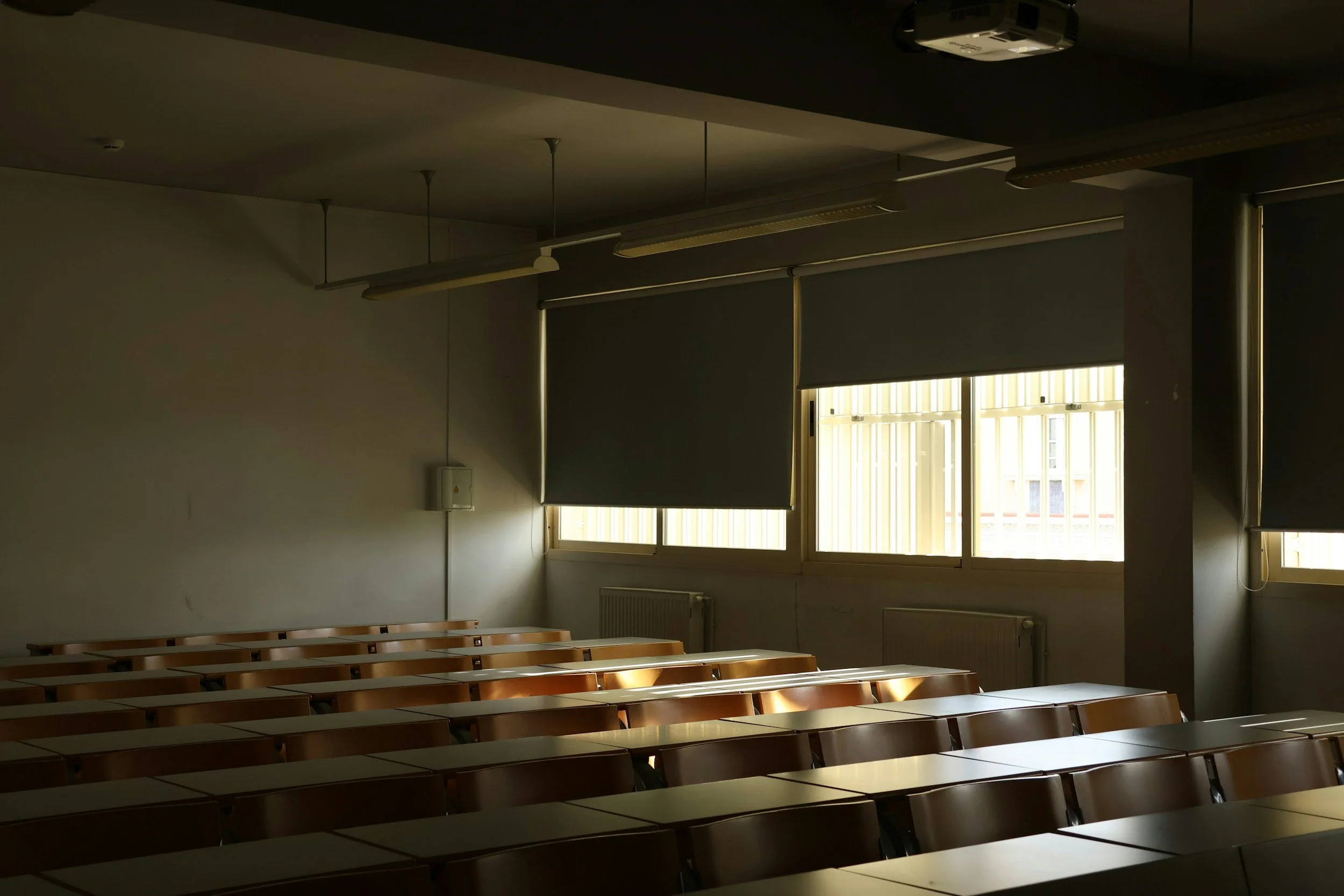
I recently walked into a school classroom, and its ambience hit me full force, but not in a good way.
Once upon a time, the walls were probably, possibly, cream? The paint was peeling off in places. There were old Blu Tack marks stuck on surfaces like fossils. An old hand sanitiser, left over from COVID days, clung eagerly to the wall just inside the door.
Grey carpet props up bare desks. Fluorescent strip lights make the whole place feel like a hospital waiting room at 2 am. There was a projector bracket fixed to the ceiling with no projector attached, just wires dangling down like everybody had given up trying. An old screen. A whiteboard stained with ghost writing from lessons long gone. And a clock that only gets the time right by accident.
The walls were decorated with a few tired sheets of A4 paper, written in Arial font; the title on one spelt “Command words”. Another, “Prime numbers.” These random portraits were laminated years ago.
Nothing in that room said energy. Nothing said possibility.
Nothing said: “We care because you matter.”
And I stood there thinking:
“If I were 15 years old, would I want to sit in here all day?” The answer was a resounding NO. And that’s the bit I think adults miss sometimes.
You see, before a teacher says a single word…
before the lesson starts…
before behaviour becomes an issue…the room has already spoken.
Young people walk into spaces and feel things instantly; we all do.
And whether we like it or not, some rooms quietly tell them:
“Nobody really cared enough to make this better.”
Then we wonder why they switch off.
We tell young people: “Your future matters.”
“You can achieve anything.”
“Believe in yourself.”
But look at some of the environments we ask them to sit in for six hours a day. No warmth. No imagination. No sense of belonging and no life.
Young people feel contradictions. Deeply.
And I don’t think the environment is a small thing. It’s a massive thing. Colour matters, lighting matters, and without a doubt, the energy it emits matters.
I think a young person should walk into a classroom and feel like somebody actually thought about them before they arrived.
Not perfection. Not expensive furniture. Not some Instagram classroom. Just thought. A bit of pride. A bit of care.
A feeling that says:
“This space was prepared with human beings in mind.”
Because when spaces feel better, people show up differently.
They sit differently, speak and engage differently.
The room should give permission before the teacher even begins.
And here’s the thought that stayed with me all day:
Prisons are designed so people don’t want to go back.
Schools should feel like the complete opposite.
Places full of life, curiosity and possibilities.
Places young people actually want to walk into.
And honestly, sometimes all that takes is a bit of effort.
A splash of colour. Quotes that make you stop and think. Student work being displayed properly. Possibly plants dotted around the place and music playing as they walk in? Um, maybe that is pushing it too far, but is it really too much to ask for the price of learning?
We need to create environments that scream, “We thought about you.” Because whether people realise it or not, every classroom tells a story before the lesson even starts. The question is:
What story is your room telling?
